This a bit different from our usual posts. We recently watched an old British sci-fi film that has a strikingly familiar relationship to the world today.
Here's a synposis. Please comment if you agree or disagree that many of the points in this film are similar to what is happening to our world today, both environmentally and politically.
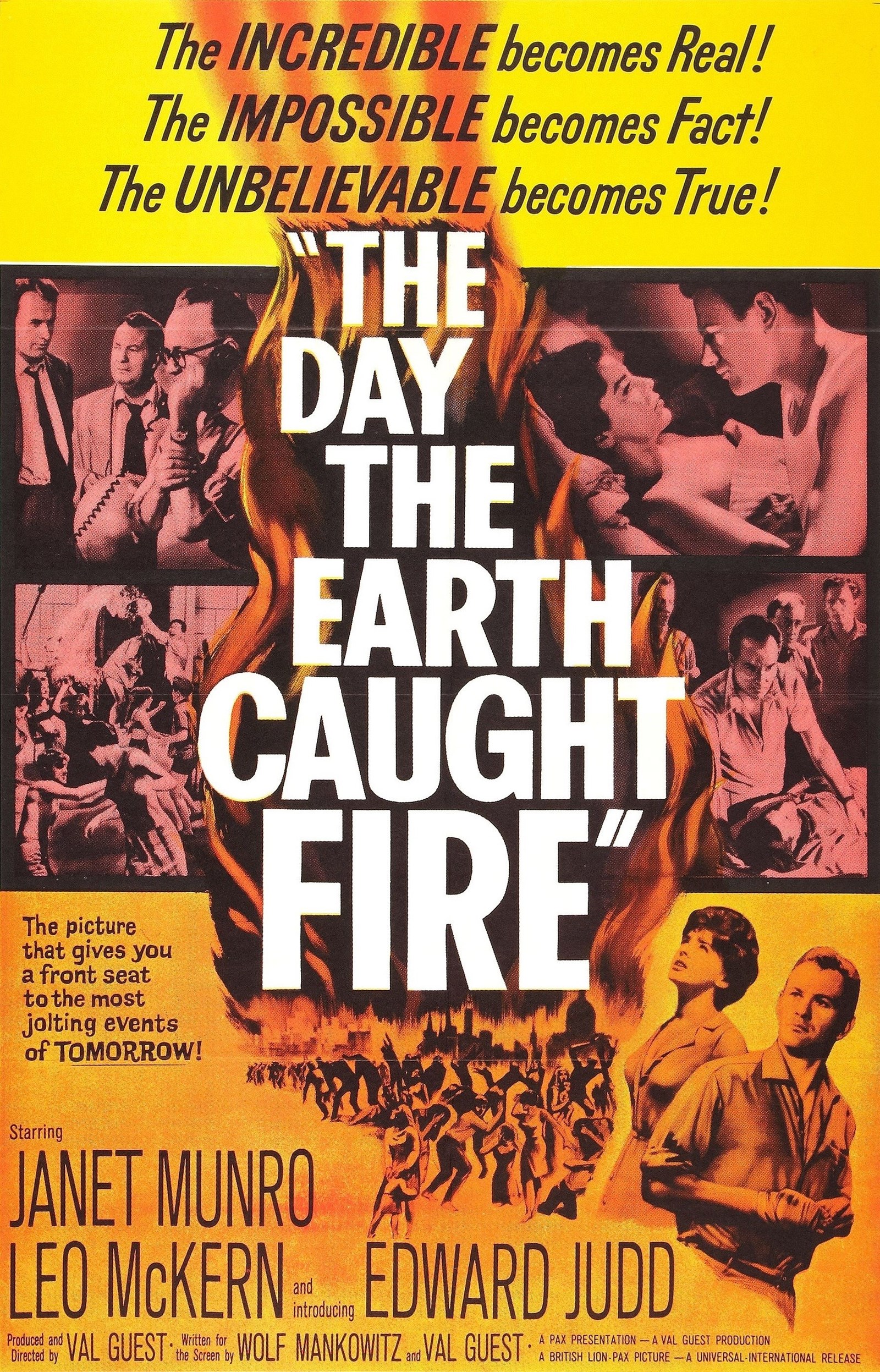
Released in 1961, The Day the Earth Caught Fire
is a classic British science-fiction disaster film that manages to feel both
like a vintage Cold War relic and a startlingly modern cautionary tale.
Movie Summary
The story is told through the eyes of Peter Stenning, a cynical,
hard-drinking journalist for the Daily Express in London. After the
United States and the Soviet Union simultaneously detonate massive nuclear
bombs, the world begins to experience freakish weather: monsoons in the desert,
massive fogs, and a relentless, skyrocketing heatwave.
Stenning and his colleague Bill Maguire discover a terrifying truth the
government is trying to suppress: the dual explosions were so powerful they
knocked the Earth 11 degrees off its axis and altered its orbit, sending the
planet spiraling toward the Sun. As London withers under a "heat
mist" and water rationing leads to riots, scientists prepare a last-ditch
effort to "kick" the Earth back into orbit with more nuclear
detonations. The film ends on a famously ambiguous note, showing two prepared
newspaper headlines: "World Saved" and "World
Doomed," while the sound of church bells (in the US version) or
silence (in the original) leaves the outcome to the viewer’s imagination.
Comparison to Modern Climate Change
While the film’s "nuclear-induced orbit shift" is
scientifically impossible, its depiction of a planet in environmental freefall
resonates deeply with today's climate crisis.
- Human-Caused Catastrophe: Both the film and modern climate
change share the central theme of anthropogenic (human-caused) disaster.
In 1961, the fear was that our technology (nuclear weapons) would destroy
us instantly; today, the fear is that our technology (fossil fuel
reliance) is destroying us gradually.
- The "Slow Burn" of
Panic: The movie masterfully depicts the transition from "it’s just a
weird summer" to "the world is ending." This mirrors the
current global experience, where what was once dismissed as "unusual
weather" is increasingly recognized as a systemic, existential
threat.
- Government Obfuscation: A major plot point involves the
British government downplaying the severity of the crisis to prevent
panic. This echoes modern frustrations regarding political
"greenwashing" or the slow pace of governmental response to
climate data.
- Social Breakdown and Resource
Scarcity: The scenes of water rationing, dried-up rivers (like the Thames in
the film), and social unrest are no longer just sci-fi tropes but are
mirrored in real-world droughts and climate-driven migration today.
- The "Technological
Fix": The film concludes with the hope that the very thing that caused
the problem (nuclear bombs) can solve it. This parallels modern debates
over geoengineering—the idea that we might use large-scale
technological interventions to "fix" the atmosphere we’ve
damaged.
"Perhaps in the next few hours, there will be no remembrance of the
past, and no hope for the future... All the works of Man will be consumed in
the great fire out of which he was created." — The Day the Earth Caught
Fire
It’s a haunting film that definitely sticks with
you—especially that final shot of the two conflicting newspaper headlines. It’s
rare for a 60-year-old movie to feel more relevant today than it did upon its
release.
Here's a link to the original movie trailer: The Day the Earth Caught Fire
Our thanks to Google's Gemini for its asistance in summarizing the above.


No comments:
Post a Comment