Cookies Notice

This site uses cookies from Google to deliver its services, to personalize ads, and to analyze traffic. Information about your use of this site is shared with Google. By using this site, you agree to its use of cookies.
Showing posts with label #greenhousegases. Show all posts

Thursday, February 12, 2026

Trump ignores science and uses a shaky legal argument to repeal EPA's previous greenhouse gas regulations

Today, despite overwhelming scientific evidence to the contrary and the objections of many, President Donald Trump's EPA finalized a rule that repeals the agency's previous decision that greenhouse gases endangered public health and welfare. By doing so, Trump reverses actions the EPA has taken to regulate the emissions of such pollutants.


As a result of this ruling, Trump's EPA can argue that it no longer has the legal authority to regulate greenhouse gases and the resultant global warming/climate change impacts they have. Additionally, EPA will now finalize the repeal of existing regulations that required strict tailpipe emission standards for cars and light trucks. 

The decision is destined to be challenged by numerous groups, however, using some of the following arguments:

1. The ruling is arbitrary and capricious under the Administrative Procedure Act.

2. Previous U.S. Supreme Court precedent (Massachusetts v. EPA, 2007) established that greenhouse gases are air pollutants subject to regulation by the EPA if they are found to endanger public health.

3. Today's decision is based on a shaky legal argument that ignores existing climate science that should result in challenges by experts in the field.

4. A slim possibility exists that Congress could develop a new law specifically directing EPA to regulate greenhouse gas emissions. However, this will be practically impossible as long as Trump remains in power and his supporters maintain majorities in the House and Senate.

Tuesday, February 10, 2026

The Day the Earth Caught Fire - a prescient vision from 65 years ago?

This a bit different from our usual posts. We recently watched an old British sci-fi film that has a strikingly familiar relationship to the world today.

Here's a synposis. Please comment if you agree or disagree that many of the points in this film are similar to what is happening to our world today, both environmentally and politically.


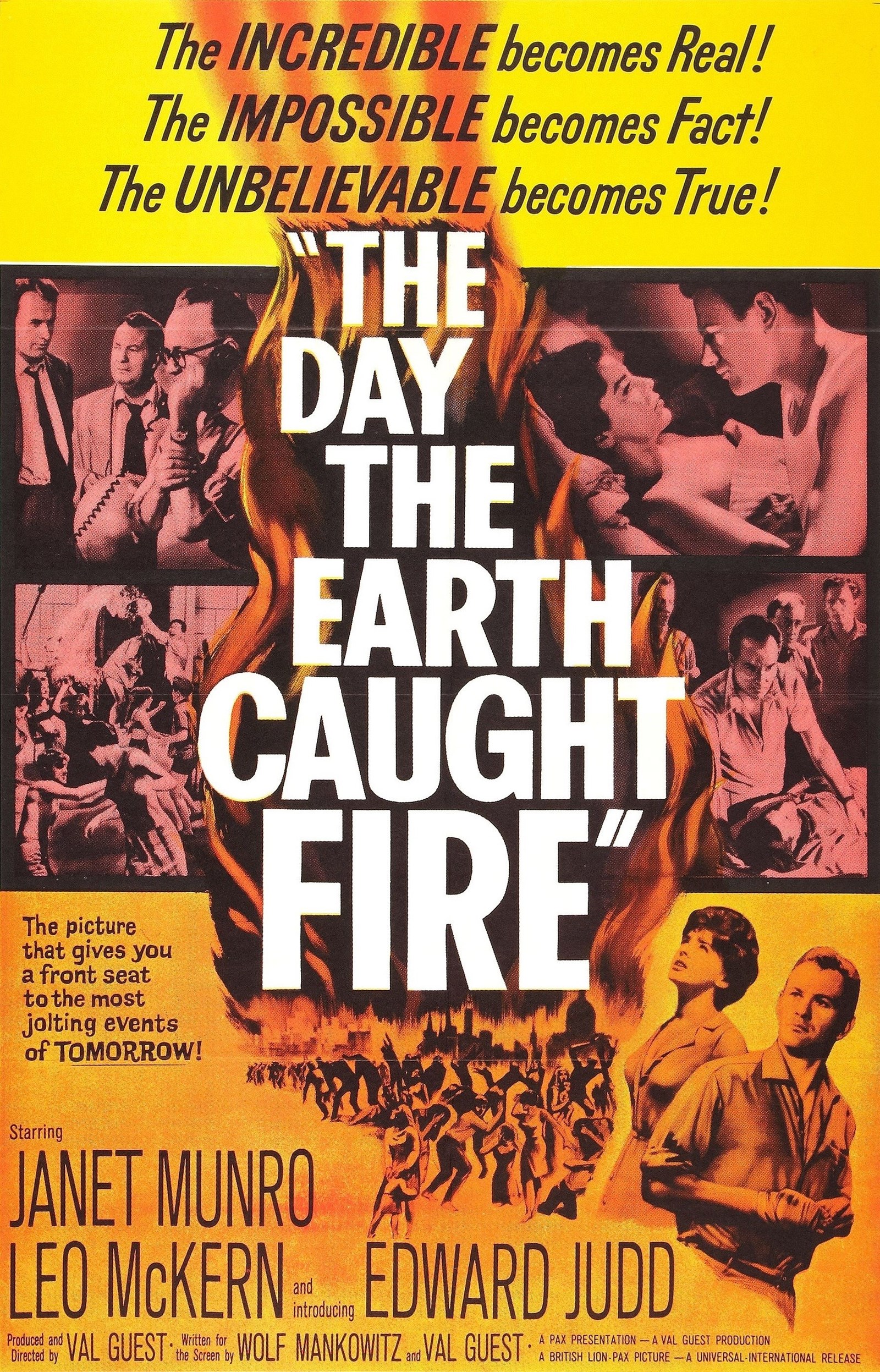
Movie Poster Credit: IMDB, Fair Use

Released in 1961, The Day the Earth Caught Fire is a classic British science-fiction disaster film that manages to feel both like a vintage Cold War relic and a startlingly modern cautionary tale.

Movie Summary

The story is told through the eyes of Peter Stenning, a cynical, hard-drinking journalist for the Daily Express in London. After the United States and the Soviet Union simultaneously detonate massive nuclear bombs, the world begins to experience freakish weather: monsoons in the desert, massive fogs, and a relentless, skyrocketing heatwave.

Stenning and his colleague Bill Maguire discover a terrifying truth the government is trying to suppress: the dual explosions were so powerful they knocked the Earth 11 degrees off its axis and altered its orbit, sending the planet spiraling toward the Sun. As London withers under a "heat mist" and water rationing leads to riots, scientists prepare a last-ditch effort to "kick" the Earth back into orbit with more nuclear detonations. The film ends on a famously ambiguous note, showing two prepared newspaper headlines: "World Saved" and "World Doomed," while the sound of church bells (in the US version) or silence (in the original) leaves the outcome to the viewer’s imagination.


Comparison to Modern Climate Change

While the film’s "nuclear-induced orbit shift" is scientifically impossible, its depiction of a planet in environmental freefall resonates deeply with today's climate crisis.

  • Human-Caused Catastrophe: Both the film and modern climate change share the central theme of anthropogenic (human-caused) disaster. In 1961, the fear was that our technology (nuclear weapons) would destroy us instantly; today, the fear is that our technology (fossil fuel reliance) is destroying us gradually.
  • The "Slow Burn" of Panic: The movie masterfully depicts the transition from "it’s just a weird summer" to "the world is ending." This mirrors the current global experience, where what was once dismissed as "unusual weather" is increasingly recognized as a systemic, existential threat.
  • Government Obfuscation: A major plot point involves the British government downplaying the severity of the crisis to prevent panic. This echoes modern frustrations regarding political "greenwashing" or the slow pace of governmental response to climate data.
  • Social Breakdown and Resource Scarcity: The scenes of water rationing, dried-up rivers (like the Thames in the film), and social unrest are no longer just sci-fi tropes but are mirrored in real-world droughts and climate-driven migration today.
  • The "Technological Fix": The film concludes with the hope that the very thing that caused the problem (nuclear bombs) can solve it. This parallels modern debates over geoengineering—the idea that we might use large-scale technological interventions to "fix" the atmosphere we’ve damaged.

"Perhaps in the next few hours, there will be no remembrance of the past, and no hope for the future... All the works of Man will be consumed in the great fire out of which he was created." — The Day the Earth Caught Fire

It’s a haunting film that definitely sticks with you—especially that final shot of the two conflicting newspaper headlines. It’s rare for a 60-year-old movie to feel more relevant today than it did upon its release.

Here's a link to the original movie trailer: The Day the Earth Caught Fire

Our thanks to Google's Gemini for its asistance in summarizing the above.


Thursday, October 16, 2025

No, reducing GHG emissions from asthma inhalers is not going to solve global warming

Sometimes, in an effort to attract viewers/hits/attention/whatever, professional journalists write headlines that make little problems seem big and ignore the bigger problems. 

Recently, CBS published a story online about GHG emissions from inhalers that people use to treat asthma and other respiratory problems. Referencing an article from the Journal of the American Medical Association (JAMA), CBS' headline was, "Inhalers produce as much carbon emissions as over 500,000 cars per year, study finds"


Photo Credit: Cnordic Nordic

Wow! That's a lot! That's concerning!! Someone should do something about that!!! We should take away all of those inhalers from those sick people who are using them and give them something else to use so that we can save the environment!!!!!

Oh geez! Please stop!

This always comes up every couple of years and diverts attention away from controlling/reducing the major sources of CO2 equivalent by focusing on what, in reality, are trivial emissions on a worldwide scale.

According to the CBS/Jama report, inhalers in the USA produced about 24.9 MILLION metric tonnes of CO2e TOTAL over 10 years. That's an average of 2.49 million tonnes per year. 

HOWEVER, total CO2e emissions in the USA are around 4.8 BILLION metric tonnes per ONE year! (Ref: Statista )

If these numbers are correct, that means inhalers contribute only 0.05% of total CO2e emissions. In other words, less than 1 tenth of a percent comes from inhalers and they're worried about them and not all of the major sources of greenhouse gases (GHG)? 

Are you kidding me?

You could eliminate all of the inhalers in the world and it wouldn't make a dent in reducing global warming! 

It's nonsense like this that prevents progress from being made to reduce emissions from significant sources of GHG.